
Originally posted in April of 2011
When Diane and I arrived at my mom’s house in southern NH in April we were stunned to see that she had a glacier in her back yard. The snow had melted in the woods and the neighbor’s yards, but she still had 2 feet of snow pack in her back yard. Right away I knew this was significant because of the headlines we read from time to time, “Glaciers Receding Everywhere.” In Europe they put blankets on glaciers to keep them from melting and here we have one expanding in suburbia.
I had to get to the bottom of it and I didn’t need core samples. I already knew what was under that glacier because I am a student of history. It all started in ancient times, when a bunch of kids were looking for a place to play tackle football. They played on my mom’s lawn until they heard the cry that ends many such adventures, “You kids get out of here!” Unfortunately, by that time the damage was done. The grass never recovered.
Instead of buckling under to suburban social norms, my mom just let nature take its course. Initially she got a good crop of crab grass. Slowly, as the years went by, moss took over the whole lawn. She is the only one I know who has a moss lawn. I think it looks fantastic and it needs no chemicals or watering.
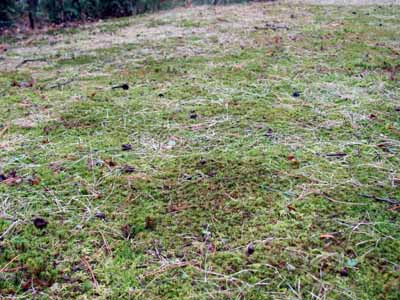
The moss lawn has its disadvantages. Most people don’t want snow in their lawns until July, but she is ready to take one for the team if it means turning the corner toward global cooling and slowing the melting of the polar ice cap to keep sea levels the way they are. A side benefit is habitat improvement. If caribou are ever get reestablished in New England, they will have a place to graze.
The insulation properties of moss are superior to that of grass or the forest floor. I learned about this when we lived in AK and saw the spruce tree/ moss/ permafrost continuum. As spruce trees grew, moss and lichen grew in the shade of the canopy. This insulated the forest floor causing the permafrost level to come near to ground level. This disturbed the roots of the spruce trees so they died. This reduced the moss and lichen layer causing the permafrost layer to go down in the soil and the whole cycle to happen again. I don’t think that my mom will get permafrost in NH.
Further study and lots of tax dollars are needed turn her lawn phenomena into national policy. I don’t think that my mom wants a pack of scientist wandering around her yard so they better use simulation models. She does, however, want credit for her part in fighting global warming.
 Adventures in Suburbia
We have a good portion of our front lawn that is moss also. Used to be thewhiffle ball field for my boys growing up.
LikeLike