
A warning to the sensitive. This blog post deals with the real issues of life in the Congo Basin rain forest, but the subject matter might be considered very crude. Read it at your own risk.
Right off the bat I will put your mind at ease. As far as I know, no one was using the facility at the time of the cave in. Imagine my shock when I arrived at Moale after a 2 month absence. When I peered inside the grass walled enclosure around the latrine, my heart dropped as I saw an eight foot in diameter and 6 foot deep crater. This presented a major inconvenience for my stay in Moale.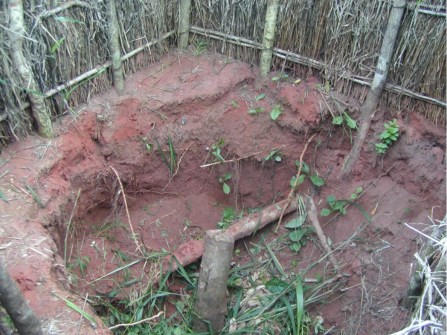
Latrines are an important tool to prevent disease in the developing world. Where people need convincing, we like to show the divine mandate for latrines found in Deuteronomy 23:12-14. Following the hygiene protocol from these verses prevents diseases ranging such as round worm, hook worm, whip worm, tape worm, blood flukes, amoebas and cholera. To define terms I will call the hole a latrine and the enclosure around the hole an outhouse, although the South Africa term “long drop” is more descriptive.
In the remote forest areas of Congo and CAR where I spend a lot of time, the people may or may not have a latrine. In the inundated forest areas of Congo you can hit water a few inches down in the soil. The water people who live in these areas paddle their dugout canoes out from their village to do their business. Little dugout canoes are so tippy that you risk going over at a moment when you are exposed and vulnerable, but a large dugout canoe makes a very stable platform for your daily effort. If more than one uses the facilities at any one time the protocol for staggering the load is starboard, port, starboard. The abundant water is great for the toilet paperless masses, but if enough people followed this practice it would pollute the water and create a risk for cholera.
When you are in a large village surrounded by water with no outhouses and have to go, the risk of spreading cholera seems a lot less important than the risk of massive pressure buildup so you do what is called a “water poop”. When you are up to your neck in the river, no one can see what you are doing. In a way you become part of the natural order as you see the fish feeding on your waste. When you are in the water they can get a little too personal when they nip at your butt. Some species of African fish live on Hippo feces. In areas where hippos are wiped out, this hygiene practice might be pulling these species of fish back from the brink of extinction.
Another issue in this part of the world is that sandy soil makes digging a deep narrow hole difficult. We all weigh risk against rewards. A log cribbing can be used to shore up a hole. The considerable work involved is easily understood, but the health benefits achieved are harder to quantify. The alternative to the latrine is a condition where you have to be careful where you walk in the forest around the village. Children can create this condition even if there is a latrine. They are a major factor in any latrine project.
When we first came to the Republic of Congo I learned about local outhouse architecture. I needed one built, so I hired a guy to do the building with planks hacked from an old dugout canoe. I expected the tall narrow outline you see at remote national parks and picnic areas. When the job was done I was surprised to see a rather short wide roofless structure. I suppose that this helps people know if the outhouse is occupied as well as improving ventilation. The large enclosure is also necessary because within the enclosure there will be a place to take a bucket shower. It sounds a little disgusting, but in terms of lack of toilet paper, economy of space and building materials it makes sense.
A big issue with latrines is making the platform to cover the hole. In remote forest areas you use logs hopefully the kind that do not rot quickly. The small hole in the center can be a slit between two logs or any kind of scrap metal available. For my first latrine we put the housing of an old push lawn mower on top to the log platform. The opening where the motor was removed made a beautiful hole. An old basin with a rusted out bottom is often used. The custom where I work seems to be to make the hold as small as possible. Aiming from the squatting position into a tiny hole is a skill you develop.
At Mbaiki I know of a latrine/outhouse built right where a 4 acre gently sloping property drains. Of course the 20 foot deep latrine hole fills up to the top when it rains. In Hawaii, a “blow hole” is a hole formed in a mass of lava that flowed into the ocean and solidified. When waves wash against the lava mass, water is forced through the hole and sprays into the air like a geyser. There is a small hole in the concrete latrine platform at Mbaiki. A heavy rain fills and creates considerable water pressure in the latrine hole forcing the effluent to spray into the air and make a loud gurgling sound. A latrine blow hole isn’t as majestic as a lava blow hole, but I was impressed when I saw it.
Back in 08 and 09, Diane & I traveled to Moale every month to do training and medical work. The latrine had reached a condition you could call high tide lapping at your feet. It is probably not a good idea to look into the hole, but if you did you would see a writhing mass of life forms. My father would have said, “That would gag a maggot”, but that is exactly what made up the writhing mass. Diane reminded me each trip that we had to do something about the latrine.
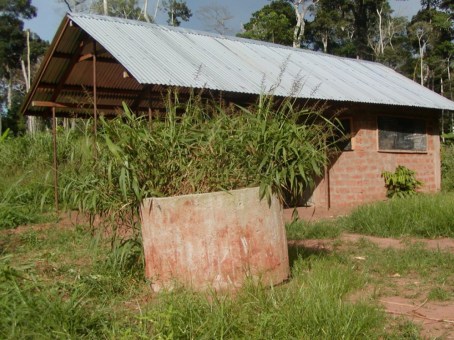
When Tim H. came with us to build a Training Center store room and work area, it was a little tricky placing the building. The sandy soil kept latrines shallow so the ideal spot for the building was dotted by old filled in latrines. A failed hand-dug well project in the area left a few 4 foot tall by 3 feet diameter sections of concrete well liners. Someone had used one for a latrine liner so that the hole could be dug deeper in the sandy soil. It had been filled in for a year, but our efforts exposed the top of the concrete well liner.
Tim and I knew that we needed it for our next latrine. We were sure that the nasty micro organisms were no longer viable so we instructed our crew to start digging out the concrete well liners. They got about three quarters of the way down, encountered something nasty and went on strike. Ever resourceful, Tim figured out how to hook a chain to it and we pulled it out of the ground with the Toyota Hilux. After that we stood it as a forest version of an obelisk. We figured that after a month the rain would sanitize it. It looks nice standing in between the Training Center building and the guest house, a trophy rescued from an old latrine.
Tim sent a Sudanese carpenter named Patrick down alone to finish the Training Center building. When he came back he reported that he had finished all his work early so he got a crew together and made us a new latrine and out house as well as filling in the old hole with the high tide. You can imagine the excitement when Tim, Hap & I went back to Moale the next time. We noticed right away that our well liner obelisk was still in place, so it had not been used for the new latrine. The new outhouse was about 10 feet square made of wood poles, vines and grass. The side corridor entry way made it very private. The platform looked solid, the hold was deeper than normal (this should have got us thinking) and the shower area was first rate. We were all well pleased with the work of Patrice and his crews. When Diane came a month later she gave her stamp of approval.
On my next visit I witnessed the devastation. After the fact we know that the hole was just too deep and wide for the unstable sandy soil. I stood there staring into the crater wondering what to do. Diane & I had left Tim’s hand crafted shower stand in the enclosure on our last trip. It was now buried under tons of soil and who knows what else. I decided that he would forgive me for leaving it where it was. Instead of ample space to get to the hole and the shower area, I was now looking at a 2 foot by 6 foot side corridor entry way and then the crater. Several potential solutions came to mind, but I like to study problems for a while before getting into the fix it mode. Eventually I put a rice sack over the end of the entry way for privacy and determined that 2 feet by six was enough space for a shower and a squat spot. Besides, with a hole eight feet across you could never miss.
 Adventures in Suburbia
Hahaha, too funny, and too real 🤣🥺🤪
LikeLike