You can find the original post called “The Moss Lawn: a Suburban Solution to Global Warming” in Adventures in Suburbia March 17, 2021. I hear from people interested in the concept so I thought I would give you an update and some pictures.
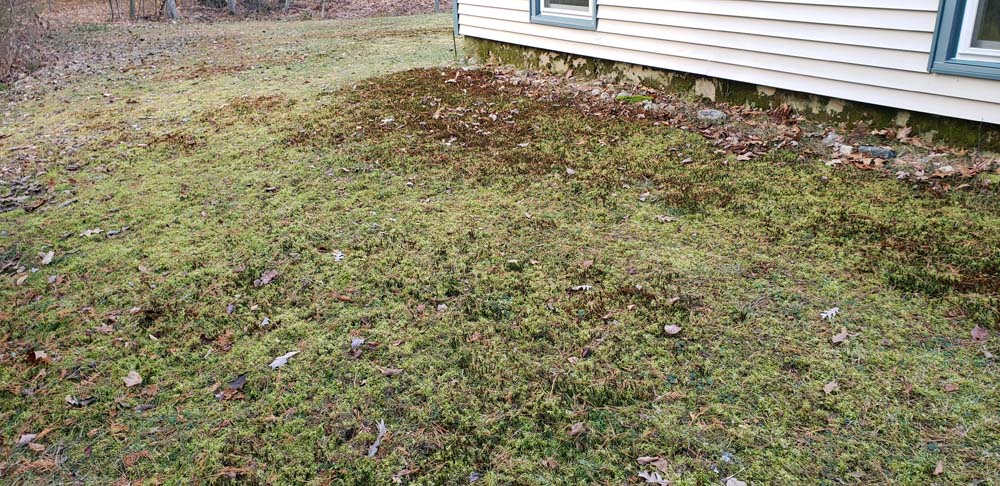
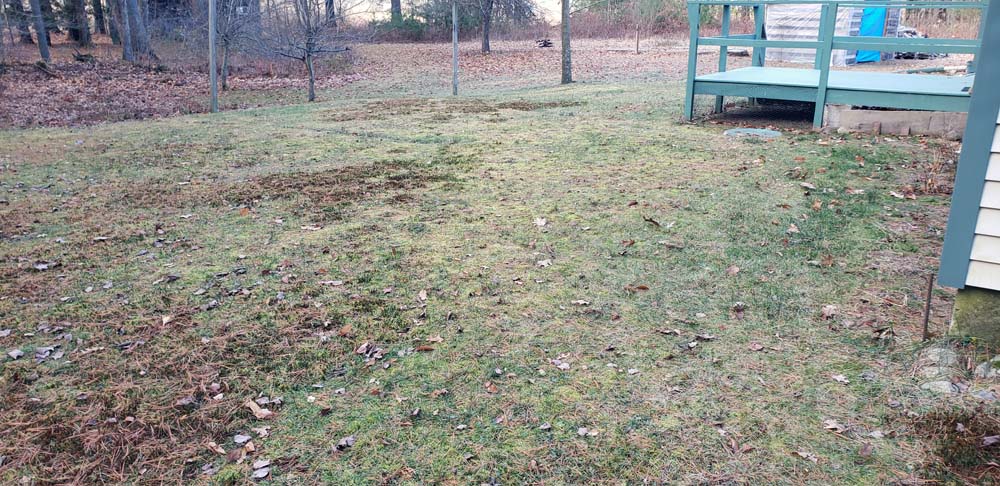
We were at my mom’s house in late Nov and early Dec. The moss is as thick as ever. We had one inch of snow. It lasted one day in the rest of the neighborhood and 1 week on the insulating cushion of moss in my mom’s yard.
The awards validating my mom’s participation in the fight against global warming continue to pour in. The insulating qualities of the moss in her yard has created an Arctic microclimate. So far when the polar bears visit they just pass through. We think that it is because there are not yet enough seals around to hold their attention. You can be sure that I will keep you up to date a on any further developments.
I hope you have an appliance repairman like DT. He came to our house and determined that our older Kenmore washing machine needed a new motor. DT has a lot of old washing machines in his back yard. He buys them cheap and sells the parts. He told me that he would look for a motor for our washer.
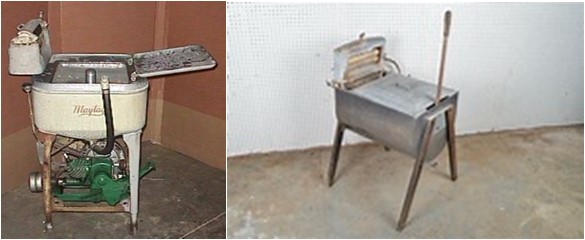
Before moving to Africa we used the coin-op washing machines in our apartment complex. When preparing to go to the Congo in 1990, we were advised to buy a gasoline powered washer, but we bought a James hand washer. In July 1990 we shipped it to Impfondo in the People’s Republic of Congo and used it 11 years. We were able to hire someone to work the agitator, but no one stayed in the position very long. An older man named Goffi watched the clothes while they were drying on the line. One day when a young boy stole a shirt Goffi became animated beyond what we expected of him and caught the fleeing boy. We always compared that incident to the elderly infirmed Yoda who trained Luke Sky Walker suddenly turning into a lively Jedi warrior fighting machine.
A Gasoline powered washing machine and a James Hand Washer
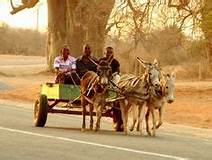
In Senegal we bought a used washing machine. When we moved from a house to an apartment, our washer’s check valve stopped working. I called a repairman who hauled it off in a donkey cart. He searched the local appliance graveyards for the part and declared it fixed. In that part of the world, the washer sits next to the shower stall where it drains (The washer we used in India drained off the balcony floor). The repair man could not fix the problem, but after I raised drain hose and tied it to the shower hot and cold water valves it worked after a fashion. There were a series of actions that had to be performed at the right time to get through a load. Every time the washer missed the rinse cycle the chairman of the board made her opinion of that machine known to all in the apartment.
I didn’t get a picture of our washer in the donkey cart.
DC and KC gave us the Kenmore model 70 that we are now using. DT says the older models perform better than the new ones. I don’t think we need a stream-lined fancy washer and dryer that look like a space capsules. The chairman of the board says that she would like a matched washer and dryer set. I respond that our machines are both white and quite similar in appearance. Besides DT’s used appliance parts service only stocks parts for older models. After the diagnosis, DT brought us a motor from one of his donner machines, but it was also frozen. Working his network, DT received another frozen motor from his friend. Finally on the fourth day after the initial service call, DT installed a used motor for a very reasonable price.
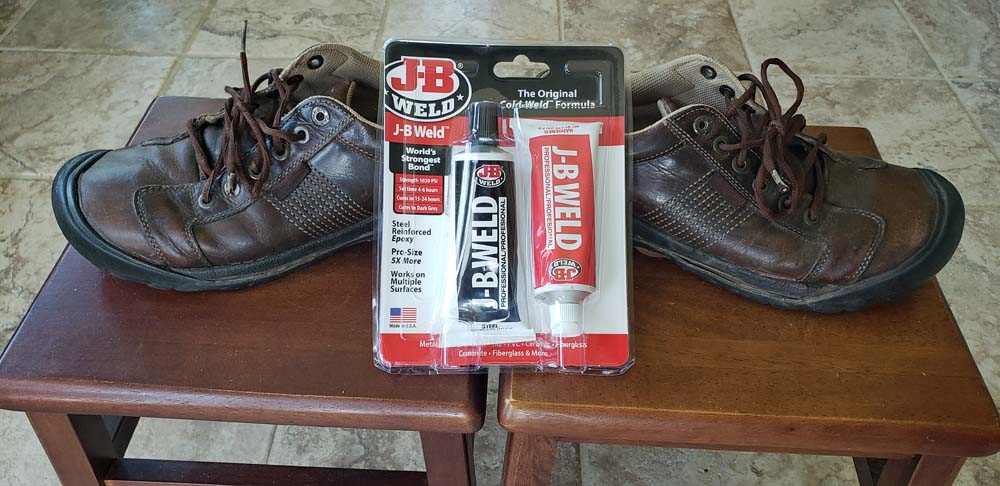
Does anyone else besides me fix their shoes when the sole starts to fall off? In my experience, this happens eventually even to the best brands. I tend to buy cheaper brands and fix them often.
For me shoe repair started as a connection with fishing. Stocking foot waders with wading boots give more support than boot foot waders when negotiating rocky trout streams. Wading shoes can have felt soles, metal studs or rubber soles (Some places outlaw felt soled wading boots because they can transport invasive organisms from one stream to another). Indoor outdoor carpet is just as good as felt for gripping slippery rocks. You can make any kind of boot into a wadding boot by gluing indoor outdoor carpet the sole, but they won’t have features like a full gusseted tongue to keep out sand and gravel or a BOA fit system. I am still working on the best DIY way to attach metal studs to wading shoes.
When I started to glue carpet to the bottom of my wading shoes, barge cement was recommended but I never had any of that. One of the wonders of the internet is that now, 40 years too late, I can have barge cement delivered to my door overnight. I have used ordinary rubber cement and automobile weather stripping cement with different levels of success.
After this experience, working on my street shoes came naturally. On a trip to the Congo once, the sole of my Keen walking shoes started flapping. It was a bad time for a shoe failure as I did not have a backup pair. Before going to bed I glued the sole back on and I was good to go the next day. I was once deep in the Congo Basin Rainforest wearing a pair of low topped North Face hiking shoes. Once again I felt the flap, flap of a disconnected shoe sole. That time repair was not an option. The foam in this high end shoe had disintegrated. Feeling the flap , flap for the rest of the trip made me less inclined to buy high priced shoes.
I am not going to tell you “how to” fix shoes, rather here is how I fix shoes. I have neither looked at or produced a YouTube video on the subject. To reattach the sole of a shoe to the upper, clean the 2 pieces with an old tooth brush and then wipe the surfaces with alcohol. These days I use JB Weld as the bonding agent of choice. Mix some up according to the instructions and apply it with a popsicle stick. Try not to make a mess. Push the 2 pieces together then wrap them with packing tape. Wrap the tape around enough times to squeeze the sole and the upper together. The next day take the tape off and you will be good to go. You can also use JB Weld to build up worn out spots on the soles, but when you walk you will hear the clacking of the JB Weld for a while until it wears down a little.
I suppose that many people throw away shoes that start to fall apart. There are not too many shoe repair shops these days so DYI is the only option. This reveals one advantage to living in the developing world. When I was in Senegal in April my sandals started to fall apart. I was staying in the Hann Mariste neighborhood with Amet & Alexia. A 3 minute walk from their house to the main road brought me to a shoe repairman who fixed them in less than an hour for $2.
Every spring we get the warning to stop feeding the birds because the bird seed attracts bears that are hungry, post hibernation. We follow this practice, but have friends who do not. Some of our friends that feed birds in the summer have trouble with racoons destroying their bird feeders. By not putting out bird seed in the summer we don’t see as many birds. In the winter we can have as many as 5 male cardinals around the bird feeder at the same time. During the summer we only see them occasionally, but we see more insect eating bird. To me it seems like harmful enablement to feed birds when their natural food is plentiful.
Feeding the birds is fun, but in the summer we are content with the birds that we can attract with habitat improvements. The chairman of the board planted poppies around the house. Each year in July goldfinches discover this food source. We put up 3 bird houses. It is fun to watch the bluebirds that have chosen one, but they do not allow another pair to use the house on the other side of the yard. The territorial bluebirds also evict Tree swallows that want to put the empty bird house to use. After the young bluebirds leave the nest, we only see the family occasionally.
We don’t enjoy the plague of big green June bugs flying around in July. One year we put out grub killer to stop them. Many grubs came to the surface and died, but I am sure that it is harmful to the birds that picked up the dying grubs. We stopped using grub killer and put up with a rising mole population. A friend told me about using grub killer to remove the food supply of the 5 skunks that were hanging around his yard each night.
A Carolina wren was able to claim the 3rd birdhouse which is obscured by some oak branches. Our patio is underneath it so I had a front row seat to family disfunction. I suppose all was fine when I was not there, but mother wren was disturbed when I was sitting on the patio. At first she flitted around nervously, but then fulfilled her family obligations. After building up her resolve she flew into the bird house to give the caterpillar in her beak to her family. The male on the other hand was a loud-mouthed slacker. He routinely arrived with a caterpillar, hopped from branch to branch, decided that it was much too dangerous to go into the birdhouse, ate the caterpillar himself and then chattered his warning to me.
The rabbits and birds like our yard because it is cat and dog free. I think that we will do more to create better summer habitat for birds.
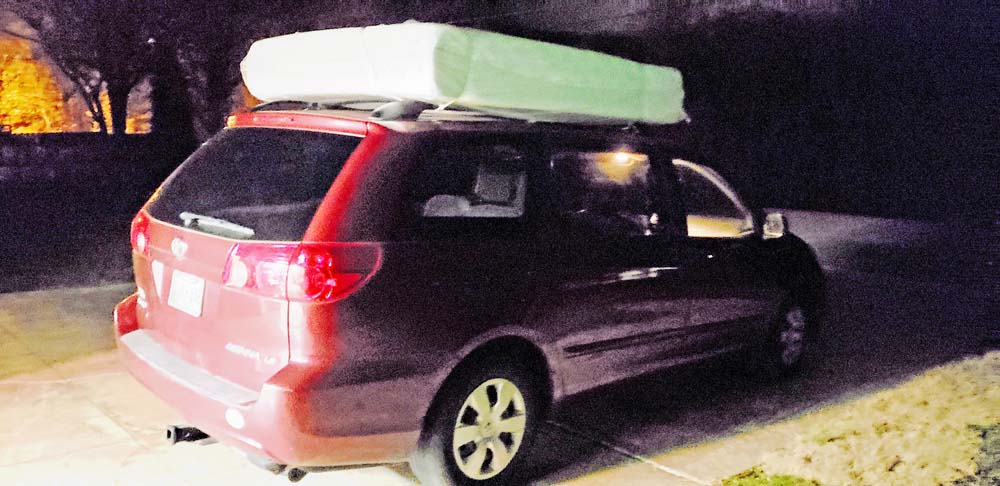
The chairman of the board and I bought a mattress at Bargain Hut in March. They don’t have a delivery option, but we didn’t need one. The salesman helped us put it on the roof of our Toyota Sienna minivan and I tied it down. As confident as I was of my knots, while driving home I aimed the left mirror up from time to time to make sure that it was still there.
Misadventure motivated me to learn to tie stuff to the roof of my car after. Growing up, my dad had his way of tying canoes to the top of his pickup truck. When I first tied one to the top of my car, I didn’t think too much about it until I turned into the pull-off alongside Lake Umbagog and put on the brakes. The canoe shot forward, flew over the hood and landed next to the water. It was a little scary, but saved us the task of unloading the canoe. I learned that day to control the forces, especially the forward momentum of the load when the brakes are applied.
When we were preparing to go to Africa for the first time we moved to Quebec for a year to study French. During the same period of time we bought equipment to ship to Africa. These activities gave us many chances to tie excess baggage to the roof of our station wagon. My dad called us Sanford and son.
I learned the value of ratchet tie downs and checking the load occasionally when we traveled the bumpy roads of Central Africa. When we were moving from Yaounde, Cameroon to Bayanga, Central African Republic, I hauled a number of loads over the route. Once, in addition to the load in the Toyota Hilux pickup, we had a mattress tied to the top. By God’s grace I just happened to looking at the mirror the moment when the mattress flew off the pickup into the air. We backed up, retrieved the mattress and tied it down again.
I now share my tie down skills with suburbanites who have little tie down experience. Have you ever seen someone at Home Depot tie 5 eight foot 2x4s to the roof of their Toyota Camry only to realize that they ran the rope through the windows and over the top and could no longer open the doors? It is embarrassing getting in through the window. When you open the doors first and run a tie down strap through the car then up and around the load you can still open the doors.
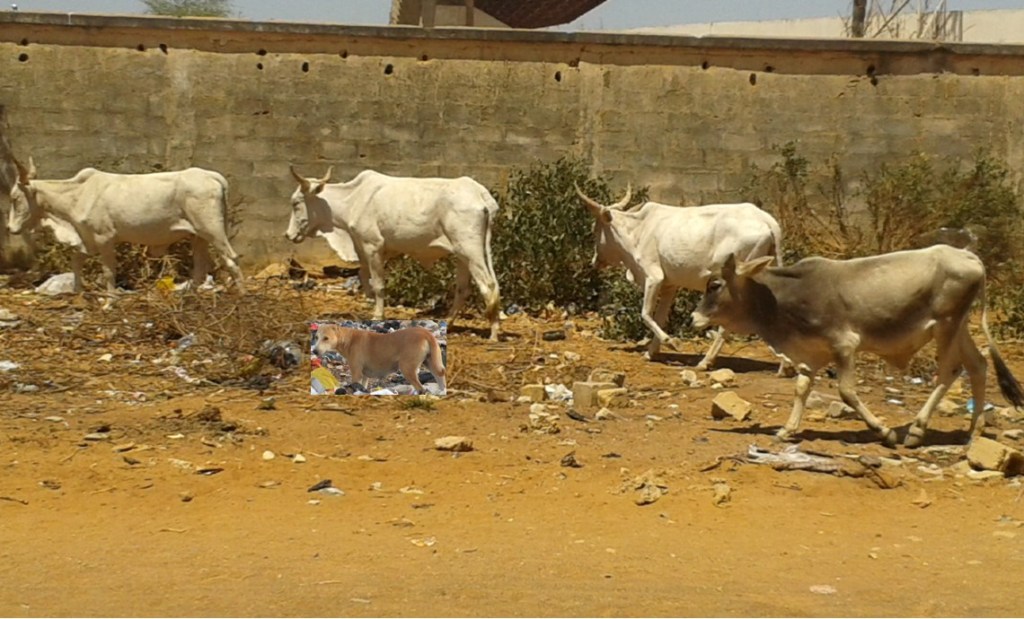
When we lived in Thies, Senegal, herders ran their cattle by the front of our house to move them to the pasture suited to the season. Several groups of cattle had dogs that were part of the herd. I wondered how they got the dogs to stay with the of cattle. (Full disclosure: I was never able to get a picture of the Thies, Senegal cattle dogs. The one attached to this post is a composite.)
The Beersheba Project tried to get their dogs to guard remote areas of the property, but the dogs just wanted to hang out at the dining hall. Brenda R. in Johannesburg, South Africa told us about a project to use Anatolian Sheep dogs to run with the goat herds to prevent cheetah predation. Anatolian sheep dog as protection from cheetahs As a result, I was quite interested when I read an account by Charles Darwin in “The Voyage of the Beagle” of how the feat was accomplished in the mid 19th century in the Patagonian Pampas.
“While staying at this estancia, I was amused with what I saw and heard of the shepherd-dogs of the country. When riding, it is a common thing to meet a large flock of sheep guarded by one or two dogs, at the distance of some miles from any house or man. I often wondered how so firm a friendship had been established. The method of education consists in separating the puppy, while very young, from the bitch, and in accustoming it to its future companions. An ewe is held three or four times a day for the little thing to suck, and a nest of wool is made for it in the sheep-pen; at no time is it allowed to associate with other dogs, or with the children of the family. The puppy is, moreover, generally castrated; so that, when grown up, it can scarcely have any feelings in common with the rest of its kind. From this education it has no wish to leave the flock, and just as another dog will defend its master, man, so will these the sheep.
It is amusing to observe, when approaching a flock, how the dog immediately advances barking, and the sheep all close in his rear, as if round the oldest ram. These dogs are also easily taught to bring home the flock, at a certain hour in the evening. Their most troublesome fault, when young, is their desire of playing with the sheep; for in their sport they sometimes gallop their poor subjects most unmercifully. The shepherd-dog comes to the house every day for some meat, and as soon as it is given him, he skulks away as if ashamed of himself. On these occasions the house-dogs are very tyrannical, and the least of them will attack and pursue the stranger. The minute, however, the latter has reached the flock, he turns round and begins to bark, and then all the house-dogs take very quickly to their heels. In a similar manner a whole pack of the hungry wild dogs will scarcely ever (and I was told by some never) venture to attack a flock guarded by even one of these faithful shepherds.”
When Diane and I arrived at my mom’s house in southern NH in April we were stunned to see that she had a glacier in her back yard. The snow had melted in the woods and the neighbor’s yards, but she still had 2 feet of snow pack in her back yard. Right away I knew this was significant because of the headlines we read from time to time, “Glaciers Receding Everywhere.” In Europe they put blankets on glaciers to keep them from melting and here we have one expanding in suburbia.
I had to get to the bottom of it and I didn’t need core samples. I already knew what was under that glacier because I am a student of history. It all started in ancient times, when a bunch of kids were looking for a place to play tackle football. They played on my mom’s lawn until they heard the cry that ends many such adventures, “You kids get out of here!” Unfortunately, by that time the damage was done. The grass never recovered.
Instead of buckling under to suburban social norms, my mom just let nature take its course. Initially she got a good crop of crab grass. Slowly, as the years went by, moss took over the whole lawn. She is the only one I know who has a moss lawn. I think it looks fantastic and it needs no chemicals or watering.
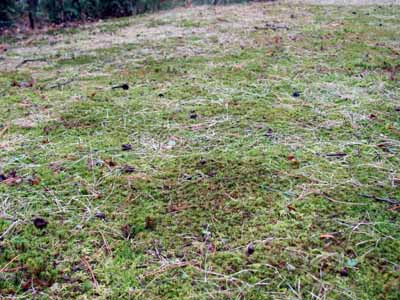
A representative section of a moss lawn in the spring.
The moss lawn has its disadvantages. Most people don’t want snow in their lawns until July, but she is ready to take one for the team if it means turning the corner toward global cooling and slowing the melting of the polar ice cap to keep sea levels the way they are. A side benefit is habitat improvement. If caribou are ever get reestablished in New England, they will have a place to graze.
The insulation properties of moss are superior to that of grass or the forest floor. I learned about this when we lived in AK and saw the spruce tree/ moss/ permafrost continuum. As spruce trees grew, moss and lichen grew in the shade of the canopy. This insulated the forest floor causing the permafrost level to come near to ground level. This disturbed the roots of the spruce trees so they died. This reduced the moss and lichen layer causing the permafrost layer to go down in the soil and the whole cycle to happen again. I don’t think that my mom will get permafrost in NH.
Further study and lots of tax dollars are needed turn her lawn phenomena into national policy. I don’t think that my mom wants a pack of scientist wandering around her yard so they better use simulation models. She does, however, want credit for her part in fighting global warming.
The other day we noticed the chicken we just cooked was going bad. It must have been at the store too long. Do you throw something like that away? Not us. We sliced it thin and fried it. My logic is that if you kill all the microbes, you won’t get sick .
We had no ill affects, and it reminded me of our old Congo river trip days. We started out with a big pot of pondu to feed the crew. Pondu is pulverized manioc leaves, dried fish and unrefined palm oil. It is eaten with the local manioc loaves called kwanga. On the first travel day after a long boat trip it is in its prime. At the village where you are camped you heat it up in the big pot you stored it in and scoop out what is needed for the day. At the end of the second day you heat it up again, killing all the microbes. I remember eating it for 3 days without ill affects, but it starts to get sour after that.
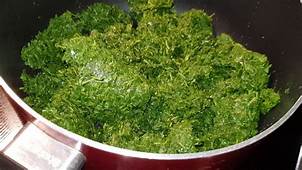
A Pot of Pondu
When someone tells us about getting sick on the potato salad at a picnic, I have to warn them about the subject they are introducing. People in our line of work in general and me in particular can go on for an hour telling food poisoning story’s.
Bad eggs made me as sick as I have ever been. During one incident at Yaloke, I thought I was going to die. I was running to the bathroom every 10 minutes for most of a day.
Once in Cameroon I took the train from Ngoundere to Yaounde. Because of misadventure (I never taken that trip without misadventure) we made the 10 hour trip in 22 hours, arriving in Yaounde at 8:30 pm. I was hungry so I went to where the street vendors sold grilled fish and chicken. The only vender still there had 3 mackerel on the grill. Who knows how long they had been there, but I purchased them and brought them to the room where I was staying. After the meal I went to bed. A short time later I woke up, shaking violently. My body decided that there was something bad in those fish. They came back up and I directed them into the toilet. After that I was fine.
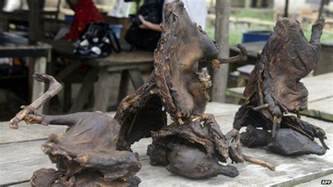
Dried bush meat looks like it would do you in, but I can’t remember ever having a problem with it. When you see it at the market there is always a few beetle larva hanging on.
Bush Meat for Sale at a Market
I once brought a big basket full of dried wild pork home with me from a ministry trip into the forest. The next morning we learned about the life cycle of the local species of maggot. They all migrated out of the meat and we found them crawling across the living room floor. That kind of meat you keep in the cook house high above the fire where it gets smoke and heat all day. It wasn’t getting that during the 2 travel days home. We put it where it would get smoke and heat. When we prepared it for a meal, it was delicious, but we gave a lot of it to friends.
At Adventures in Suburbia we have high standards so I left out some details that might be considered crude. I have plenty of stories left so someday there might be a post entitled “Food Poisoning 2”.
After visiting the area where this incident took place, I wrote this account in Feb. 1998.
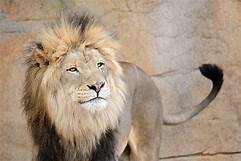
The Likouala Region of the Republic of Congo is completely covered by the rain forest of the Congo basin. This forest is the home of a wide variety of animals uniquly suited to life under the dense green canopy including elephants, gorillas and leopards. To the north of the Congo however, in the Central African Republic, the rain forest gives way to Savannah. As the confines of the forest open up into grasslands, the lion becomes the apex predator.
In 1964, a young male lion of the Central African savannahs was looking for a territory of its own. He accidentally entered deep into the rain forest. In seeking to return to the Savannah he mistakenly traveled south. Lions feed on the antelope of the African plains. The antelope and duikers of the forest required more stealth to catch than this lion was able to muster. He got more hungry by the day.
Eventually he traveled 90 miles and arrived at the Congolese village of Mindjoukou. Many lions that are no longer able to feed themselves become man-eaters and this one was no exception. It struck terror into the hearts of the villagers killing and eating 4 people. After several failed attempts, they were eventually able to kill it with an enlarged version of a traditional leopard trap.
If you go to Mindjoukou and ask about this tragedy, however, you will hear a different story. One day a fetisher from Mindjoukou discovered his wife left him for another man. Vowing to get even he walked 5 miles to the village of Moumpoutou. Here he went to see a fetisher from the Central African Republic who had settled in the Congo. This Central African had brought with him a lion who hunted for his master because of a mystical relationship between them.
The Congolese fetisher asked and received permission to borrow the lion. He used it as his instrument of revenge. The lion killed his former wife while she was working in her garden. Her family became concerned when she did not return. The next day her lover went to find her and met the same fate. The lion then killed and ate 2 more members of the family because they did not intervene in this marriage dispute on behalf of the fetisher from Congo.
Gripped by terror, the villagers in mass seized both fetishers demanding the death of the lion. They responded that as a result of having 2 masters the lion was now out of their control. In order to avoid death at the hands of the frenzied mob, they were able to describe the kind of trap that if baited with a live goat, would catch the lion. The third attempt was successful and the lion was killed inside the trap. The 2 fetishers were then delivered over to the police in the Regional capital Impfondo. The two contrasting stories illustrate the need for cross cultural workers to function at the world view level of host people.
The horn on our mini van stared working intermittently then it stopped working all together. The first mechanic said that our model had a complicated horn mechanism so the part alone would be $400. We had to evaluate how badly we needed the horn. Fortunately, when it was at the dealer for service, they discovered that the problem was just a loose connection.
Our experience in South Asia has showed us how valuable the horn is in that part of the world. I am not sure why drivers in that area use their horn so much. Some say that, “People honk pointlessly, repeatedly and continuously. Sometimes out of frustration, or sometimes out of the fear of encountering an idiot.” I once read a story that Dave Barry wrote about New York City. He decided that the cab drivers honk to pass on the valuable information, “This vehicle is equipped with a horn.”
This year I read in a couple of newspapers about a solution to the car horn noise pollution problem in large cities. Municiple officials connect the traffic signal to a decibel meter. When the honking gets too loud, the waiting time for the green light is reset and the motorists are punished by having to wait longer. Here are a couple of pictures and a link to the story.
Honking causes noise pollution and has an adverse effect on health.
MUMBAI: The city traffic police have conducted trials of what could be a solution to the menace of needless honking—a punishing signal. Special decibel meters were connected to traffic signals at five locations and when noise exceeding 85dB was recorded, the signal timer would reset itself.



 Adventures in Suburbia